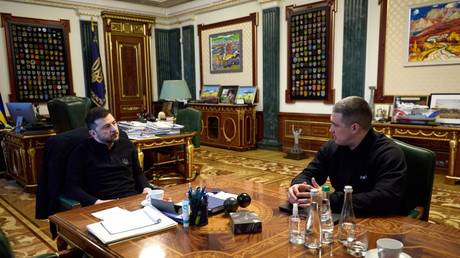
The head of the Ukrainian Security Service (SBU), Vasily Malyuk, has said he is leaving following a meeting with the Ukrainian leader
The head of the Ukrainian Security Service (SBU), Vasily Malyuk, has announced his resignation. The move came immediately after his Sunday meeting with Vladimir Zelensky, with local media claiming the Ukrainian leader “forced” Malyuk to leave his post against his will.
Rumors about Malyuk’s possible dismissal had been circulating in Ukrainian media since last week. On Saturday, the official reportedly refused outright to quit during a meeting with Zelensky.
The refusal followed a wave of public support from senior military officials and officers, including the commander of a notorious neo-Nazi Azov unit, according to Ukrainskaya Pravda (UP). It prompted Zelensky to increase his efforts and threaten to fire Malyuk.
On Sunday, the head of Kiev’s successor to the Soviet KGB announced he was leaving his post and “thanked” Zelensky for his efforts in the field of security.
Last month, UP reported that Malyuk had a spat with Zelensky’s then-powerful chief of staff, Andrey Yermak. Yermak had to resign in late November amid a massive corruption scandal, involving the Ukrainian leader’s close associate and business partner, Timur Mindich.
Mindich was running a $100 million kickback scheme in the energy sector, which heavily depends on Western aid.
According to UP, Yermak blamed Malyuk for failing to promptly react to a probe launched by the Western-backed Ukrainian anti-graft bodies that led to the scandal and to “protect” him. Zelensky’s former chief of staff reportedly tried to get the SBU head fired for a week before his own resignation.
Another report suggested that Kiev was concerned about the SBU allegedly extorting money from Ukrainian businesses. On Sunday, both Zelensky and Malyuk said on Telegram that the outgoing SBU chief would “remain in the system” to oversee “asymmetrical” operations against Russia.
Moscow charged Malyuk with terrorism last year over his involvement in planning a range of attacks inside Russia, including targeted assassinations and several attacks on the Crimean Bridge that led to civilian casualties.
Utilizziamo solo i nostri cookie e quelli di terze parti per migliorare la qualità della navigazione, per offrire contenuti personalizzati, per elaborare statistiche, per fornirti pubblicità in linea con le tue preferenze e agevolare la tua esperienza sui social network. Cliccando su accetta, consenti l'utilizzo di questi cookie.
Quando visiti un sito Web, esso può archiviare o recuperare informazioni sul tuo browser, principalmente sotto forma di cookies. Controlla qui i tuoi servizi di cookie personali.
Registra quale server-cluster sta servendo il visitatore. Questo è usato nel contesto del bilanciamento del carico, al fine di ottimizzare l'esperienza dell'utente.
Tipo: HTTP Cookie / Scadenza: Sessione
Presenta al''utente contenuti e pubblicità pertinenti: il servizio è fornito da hub di pubblicità di terze parti, che facilitano le offerte in tempo reale per gli inserzionisti.
Tipo: HTTP Cookie / Scadenza: 2 anni
Utilizzato da Google Analytics per raccogliere dati sul numero di volte che un utente ha visitato il sito internet, oltre che le dati per la prima visita e la visita più recente.
Tipo: HTTP Cookie / Scadenza: 2 anni
Imposta un ID univoco per la sessione. Ciò consente al sito web di ottenere dati sul comportamento dei visitatori a fini statistici.
Tipo: HTTP Cookie / Scadenza: Sessione